Most organisations now have more software than they have coherent software. Documents sit in one system, structured data in another, campaigns somewhere else and scheduling in another platform again. Customer records, files, meetings and workflow logic are spread across an expanding SaaS estate, then connected through APIs, automation platforms and increasingly Model Context Protocol (MCP) integrations. Every individual product may work well. The operating model around them often does not.
That is what makes Team Brain worth examining. Based on its public website and documentation, Team Brain is attempting to combine capabilities normally distributed across products such as Notion, Airtable, Lovable, DocSend, Calendly, Google Workspace and Mailchimp. Its proposition includes documents, databases, agents, reusable skills, integrations, websites and virtual machines inside a common workspace. It also says users can connect existing AI subscriptions and external services rather than relying exclusively on a proprietary model stack.
We have not yet had access to the product, so this is not a hands-on review. The useful question is what the architecture could mean for businesses if the public proposition works as described. The potential shift is significant: instead of selecting applications first and integrating them afterwards, an organisation could increasingly describe an outcome and allow an AI-native workspace to compose the software environment around it.
The proposition starts with the outcome
Traditional business software starts with a category. A company decides it needs customer relationship management, so it buys a CRM. It needs project management, so it adds another platform. Marketing automation introduces another. Document collaboration adds another. Someone then configures fields, permissions, workflows and integrations between them.
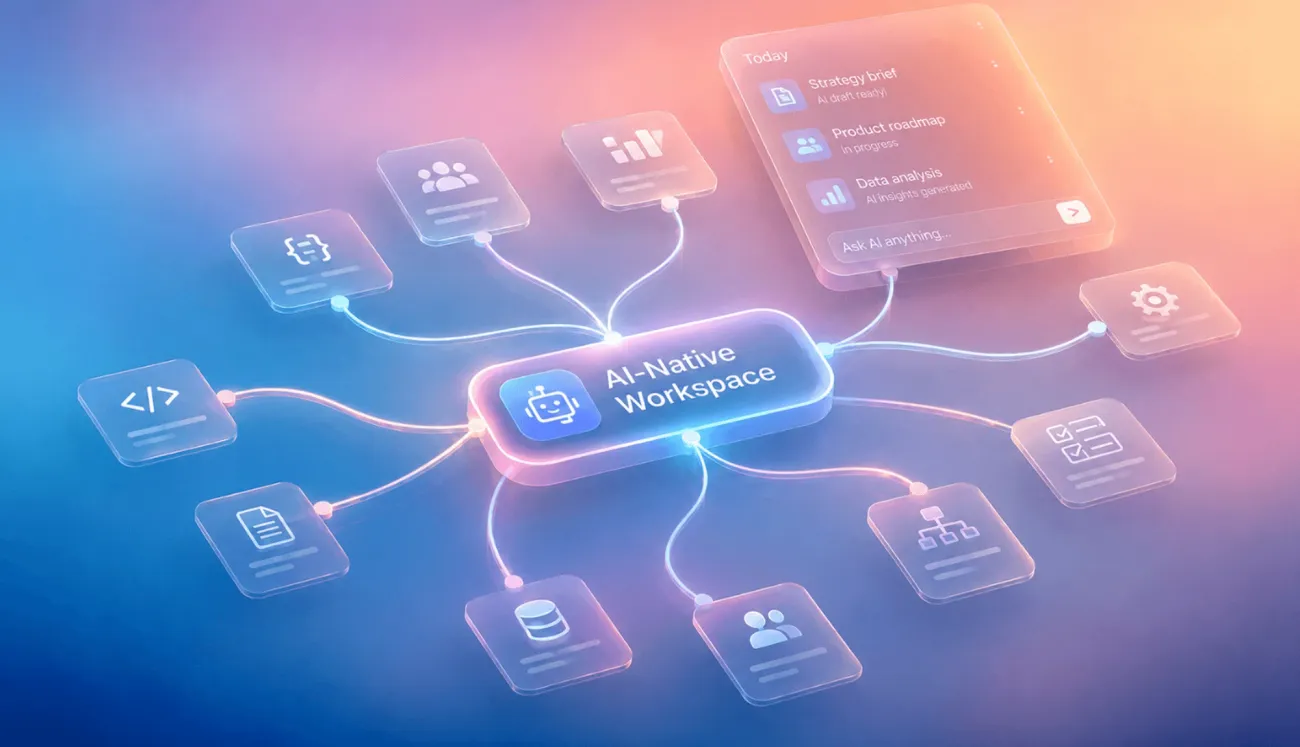
Team Brain presents a different starting point. Its homepage says Brain can build an entire AI project, creating agents, skills, pages, databases, folders, sites and integrations, and starting a virtual machine when the work requires one. The user does not necessarily need to define each underlying component in advance. That changes the unit of design.
Imagine asking for a system to manage new-business opportunities from initial enquiry through qualification, research, proposal, meeting booking and follow-up. The conventional route starts by choosing products. The alternative implied by Team Brain starts with the desired operating process and works backwards to the capabilities required: structured records, workflow triggers, company research, email, documents, calendar access, reminders, reporting and permissions.
The distinction is important. One approach asks: which applications do we need? The other asks: what outcome are we trying to create, and which capabilities does that require? If Team Brain's approach proves reliable in practice, that would move business software from configuration towards composition.
The bigger opportunity may be reducing fragmented context
Licence consolidation is an obvious potential benefit, but it may not be the most important one. The larger cost of the modern SaaS estate is often fragmentation. A customer record might sit in a CRM, the proposal in a drive, meeting notes in another workspace and campaign activity somewhere else again. An AI assistant may be able to access several of those systems, but it still has to reconstruct the business context from separate sources.
Team Brain's own explanation of a “company brain” is built around avoiding that fragmentation. It proposes keeping structured databases, documents and files together so AI agents can operate against the same information the organisation itself uses. Its database proposition makes the same point more explicitly: structured data, documents, files and automation become more useful when they remain connected, because an agent can follow relationships without crossing application boundaries.
The potential business benefit is therefore not simply having fewer tabs open. It is reducing the amount of work required to move context between systems. That matters because context increasingly determines how useful AI can become. A strong model cannot infer which customer is waiting for approval, what commercial decision was made last week or whether a proposal has changed unless that information is available in a usable form. If the workspace holds the current state and the agents act directly on it, context becomes operational rather than something users repeatedly have to provide.
Agents become part of the workspace rather than an add-on
Team Brain also presents a relatively clear model for automation. Its public material describes three components: agents, skills and triggers. Agents perform defined jobs, skills provide reusable capabilities and triggers determine when work should begin. Crucially, Team Brain says these components operate against the same documents, databases and files used by the team.
That suggests a different relationship between AI and business systems. Instead of an assistant sitting outside the process and generating a draft for someone to copy elsewhere, an agent can potentially operate inside the workspace itself. A new prospect could trigger enrichment. An incoming email could update the relevant record. A scheduled process could identify opportunities that have stalled. A reusable company-research skill could support several workflows without being rebuilt each time.
Team Brain's own CRM example follows this pattern, showing agents enriching new contacts, cleaning duplicates, drafting follow-ups, logging incoming emails and producing daily pipeline digests. These are vendor-authored examples rather than independently validated outcomes, but they demonstrate the intended operating model. The potential productivity gain is not simply faster content generation. It is less coordination work.
MCP makes the workspace more interesting
The Model Context Protocol adds another important dimension. Team Brain exposes its workspace through an MCP server that allows compatible AI clients to list databases, create rows, edit documents and run agents. Its current documentation provides examples for Claude Code, Claude Desktop and Cursor. That means the proposition is not necessarily tied to a single conversational interface.
In architectural terms, Team Brain could potentially act as the shared operational context while different AI clients interact with it. That separation matters because models and AI interfaces are changing quickly. Organisations are unlikely to want their operational data and workflow definitions locked permanently to whichever assistant happens to be strongest at a particular moment.
If a workspace exposes its data and actions through standardised interfaces, the more durable asset may become the context and workflow layer rather than the model sitting above it. There is an important control consideration here, however. Team Brain's own MCP documentation warns that anyone possessing a workspace token can read or write everything available to that token. That underlines why identity, scoped access, credential management and auditability would need careful assessment before enterprise use.
Compute becomes another workspace capability
Virtual machines make Team Brain's proposition less conventional. The platform says users can launch virtual machines manually or let Brain start and stop machines as work requires them, including to avoid paying for idle capacity. At first, that seems disconnected from documents and databases. It is actually consistent with the wider architecture.
Agents eventually encounter tasks that cannot be completed through text generation or a straightforward API. They may need a browser, specialist libraries, a runtime, persistent processes or access to software running in a controlled environment. In most organisations, that creates a boundary between the business application and infrastructure teams. Team Brain's proposition is that compute can sit inside the same orchestration environment.
The playful example of making a virtual machine available as a shared family Minecraft computer demonstrates the flexibility, but the business implication is more relevant: infrastructure could become another resource that the workflow acquires when required. That begins to collapse the distinction between workspace software and execution infrastructure.
The business case could favour smaller organisations first
The near-term opportunity looks particularly interesting for smaller knowledge businesses. A consultancy, agency, investment firm or startup may need CRM, documents, project tracking, email, scheduling, lightweight applications, automation and AI. What it often does not need is the complete feature set of seven separate enterprise products. The challenge is that assembling lighter tools can create its own integration burden.
An AI-native workspace potentially changes that trade-off. A small team could theoretically create a CRM around its actual sales process, associate proposals and meeting notes directly with the relevant records, add enrichment and follow-up agents, and expose selected data through a client-facing site without starting with a traditional suite of separate applications.
Team Brain's public examples around CRM automation and lean startup operations illustrate the kind of use cases it is targeting. Again, these should be treated as product positioning rather than independent proof of realised savings. The potential benefit is not that every established SaaS product becomes unnecessary. It is that a smaller organisation may be able to avoid building such a fragmented estate in the first place.
Enterprise adoption creates a more difficult trade-off
The same architecture becomes more consequential at enterprise scale. Combining documents, databases, agents, integrations, websites and compute in a common operating layer creates a potentially powerful shared context. It also concentrates dependency. If that environment becomes the place where organisational data and automated execution meet, questions around identity, data residency, retention, encryption, audit trails, resilience, privileged access, separation of duties and supplier assurance become central.
This is not a criticism specific to Team Brain. It is the logical consequence of the category. The more application boundaries a platform removes, the more important the remaining boundary becomes. Portability is therefore another area that would need to be tested. Organisations should understand whether databases, documents, agent definitions, generated applications and workflow logic can be exported or moved elsewhere, and what continues to operate if the workspace itself is unavailable.
Consolidation can reduce integration complexity while increasing platform dependency. Both sides of that equation matter.
The interesting comparison is not Brain versus Notion
The easiest way to evaluate Team Brain would be through a feature comparison. Does its database match Airtable? Are its documents as polished as Notion? Can its application builder compete with Lovable? Is its campaign functionality as capable as Mailchimp? That may be the wrong test.
Specialist applications are likely to remain stronger at many specialist tasks. The more interesting architectural question is whether those tasks still need to live in separate products. The dominant SaaS model of the past 15 years decomposed business software into specialised applications joined through APIs and integration platforms. Team Brain represents the possibility of pressure in the opposite direction.
If AI can generate schemas, interfaces, agents and workflow logic dynamically, then the fixed application boundary becomes less important. The workspace can become a shared state in which documents, databases, automations and generated interfaces are simply different ways of interacting with the same underlying business context. That would make the workspace less like a productivity suite and more like an operating environment.
The business case is orchestration, not consolidation
Team Brain remains an emerging proposition, and the evidence currently available to us is largely supplied by Team Brain itself. We have not yet validated its usability, reliability, security controls, integration depth or ability to replace established products in production. Those questions matter, but they do not make the architectural idea less interesting.
The public proposition already demonstrates a clear direction: Team Brain is attempting to combine structured data, documents, agents, reusable skills, MCP connectivity and compute inside a common workspace, while allowing users to describe an outcome and have the system create at least part of the supporting structure. For years, organisations have selected applications first and then spent significant effort making them work together. Team Brain asks what happens if that sequence is reversed.
Start with the work. Define the outcome. Let the system assemble or connect the capabilities required to deliver it. If that approach proves robust, the business benefit could extend well beyond fewer licences. It could mean less duplicated context, fewer brittle integrations, less manual configuration and a shorter path between a business requirement and an operational system.
That is the proposition worth testing. The important question is not whether Team Brain can replace Notion, Airtable or Mailchimp feature for feature. It is whether AI-native workspaces can make organisations need fewer application boundaries in the first place.