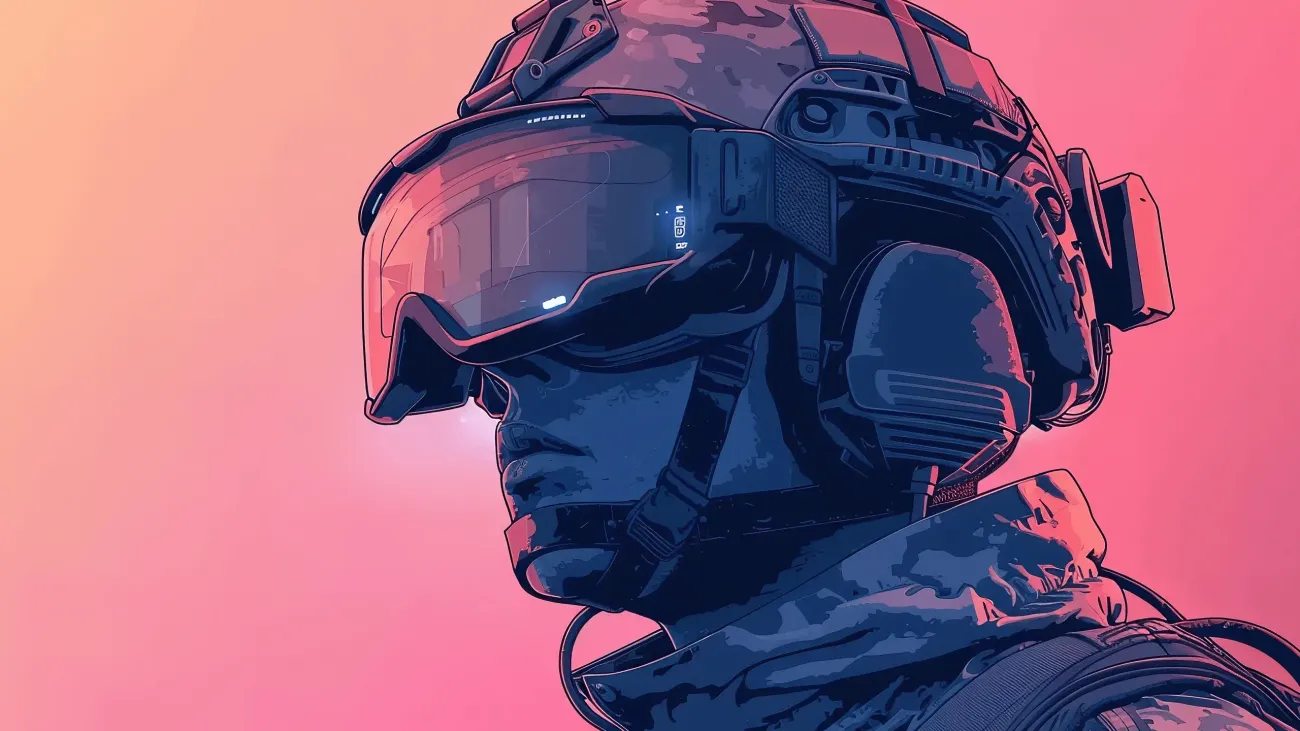
When the helmet sees first
It starts with a flash on a visor.
Imagine a soldier looking out across a ridge. Only they are not really looking. Their helmet is. In the corner of their view, a red marker pulses: an enemy drone, 400 metres away. A blue circle glows nearby: a friendly unit. The soldier does not glance down or pause. They already know.
This is the promise of EagleEye, a mixed-reality helmet and headset system that Anduril Industries unveiled in October 2025. It is built to combine AI, augmented reality and human awareness into one system. It arrived weeks after Anduril won a $159 million US Army contract to build a prototype helmet-mounted mixed-reality system under the Soldier Borne Mission Command programme, which follows the Army's earlier IVAS project with Microsoft.
A link between soldier and machine
Connected to the company's Lattice software platform, EagleEye is designed to work as a command centre worn on the head, drawing on combined sensor feeds as things happen. Anduril has shown helmet, visor and glasses versions.
Through an augmented reality overlay, soldiers get a constantly updated stream of battlefield information: terrain maps, warnings of threats, where units are and even live data from drones. Anduril describes features such as tracking teammates inside buildings and across terrain, along with extra sensing meant to warn of threats the wearer cannot see. The helmet interprets what is happening as well as showing it.
EagleEye is designed to let soldiers work with unmanned systems, including drone swarms and robots. Tasks that used to mean looking at screens or radios can be done with gestures or voice, without looking away. The aim is to let soldiers see before they are seen.
From the age of information to the age of perception
EagleEye is also an early example of how people and machines will work together in industries far beyond defence.
For years, technology has focused on helping people get more done: the laptop, the smartphone, the wearable. EagleEye shows what happens when that help surrounds you, so people think through the technology as well as using it.
Devices like this add context to data by laying meaning directly over what we see. The effects reach into logistics, healthcare, manufacturing and more.
Surgeons could be guided by AI overlays during complex operations. Engineers could see live data about infrastructure through AR visors, and field teams could share a lasting digital layer over the real world.
Anduril's partners on EagleEye, including Meta, Qualcomm, Gentex and Oakley Standard Issue, are building for soldiers first. The same design could become a blueprint for AI systems that improve how people perform elsewhere.
The business lesson is that the interface is becoming what sets products apart. Whoever controls the layer between what people perceive and what machines know will shape how we see and what we decide.
Perception is power
When machines extend what people can perceive, they also extend power.
EagleEye promises better awareness, faster decisions and more safety. It also raises a question: what happens when human instinct is filtered through what a machine tells us?
The question is how the use of tools like this is governed, as well as whether they can be built. Military AI also raises questions that go well beyond business, about autonomy in the use of force, accountability and escalation. Those deserve their own debate. This piece focuses on what the interface teaches us about designing for people and machines together.
On the battlefield, that governance might mean strict rules on explaining what the AI is doing, or ethical limits on autonomy. In business, it means frameworks that keep a person in the loop, so AI supports judgement and does not replace it. Our post on why human-in-the-loop is not a safety strategy looks at how to design that oversight so it actually works.
When people rely on AI to interpret reality for them, being empowered can turn into being dependent. Which of the two it becomes depends on how the technology is built into human decision-making.
Lessons for designing AI-assisted work
Companies putting AI into people's line of sight, whether through AR headsets in a warehouse or overlays in an operating theatre, can borrow these principles:
- Show less. Only show what changes the next decision. Clutter slows people down.
- Make confidence visible. Show the difference between what the system knows and what it is guessing.
- Keep the human decision clear. Design so people confirm important actions instead of drifting into accepting whatever is shown.
- Plan for failure. Decide what people do when the overlay is wrong, late or missing, and train for it.
- Record what was shown. Keep a record of what the system displayed, so decisions can be reviewed afterwards.
A glimpse of people with AI-boosted senses
EagleEye gives a glimpse of a new kind of human ability: perception boosted by computing, awareness that reaches beyond the senses and choices made together with algorithms.
It shows what is coming: human thinking combined with the context machines can provide. Our post on when the machines take initiative looks at the same shift in company systems.
For business leaders, the lesson is practical. As AI and augmented reality come together, the task is to design systems that make people more aware of their decisions, their data and their impact, as well as faster.


