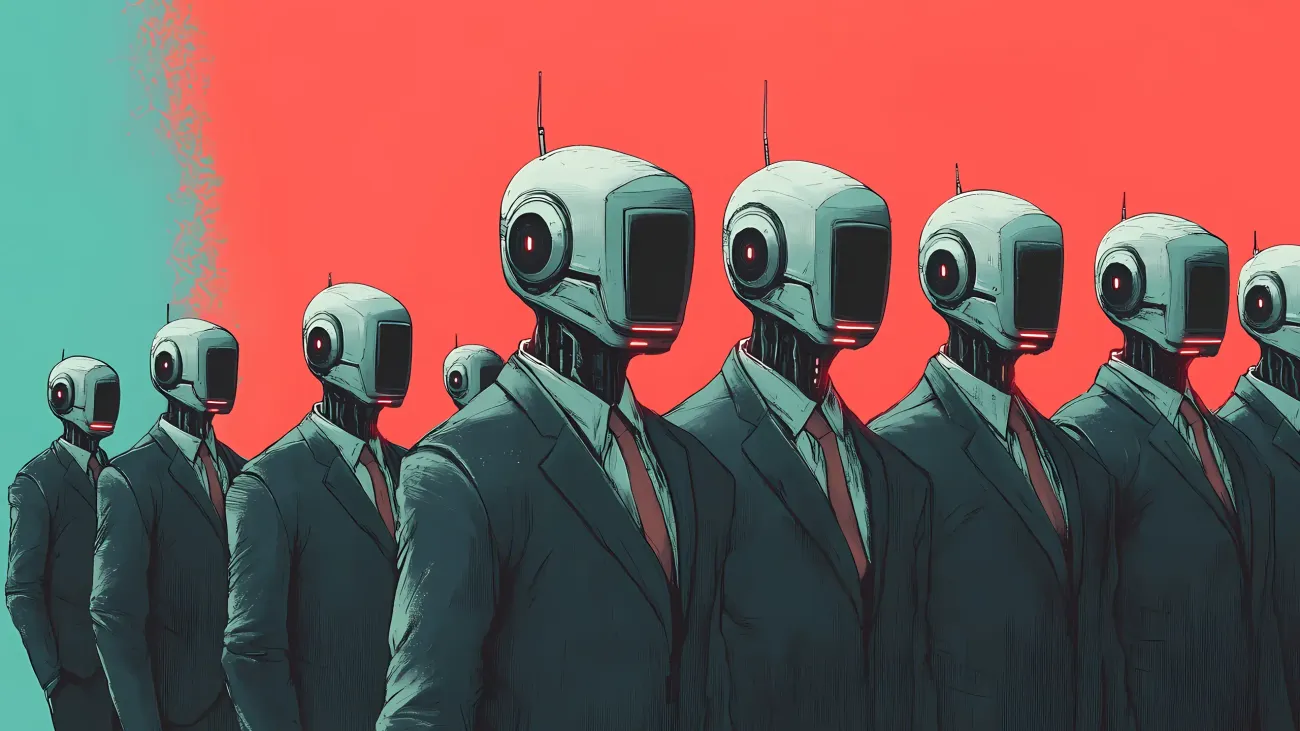
Imagine the moment the shift arrives. A contact centre manager looks at a dashboard during a Monday stand-up and stops. Overnight, the AI agents have handled more conversations than the whole human team. Demand has not dropped and headcount has not changed. The machines kept answering and passing on cases long after people logged off, and no alerts went off.
Changes like this tend to show up first as a number on a dashboard.
AI service arrives quietly
Across industries, real roll-outs show the same pattern. In some companies AI already handles a large share of incoming contacts, changing how service works long before leaders have updated their staffing plans.
The examples are public:
- Klarna reported that its AI assistant handled two-thirds of its customer service chats in its first month, the work of 700 full-time staff.
- Frontier Airlines dropped its customer service phone line in 2022 in favour of digital service, and its AI supplier, Cognigy, says the airline's AI agent handles around 800,000 conversations a month.
- Trainline built an AI travel assistant that answers everything from refund requests to live train information, drawing on around 700,000 carefully chosen pages of information.
These are ways of running the business, well past the trial stage. In each one, AI shares the work out differently without getting rid of it. Machines handle what is predictable, and people handle what is emotional, complex or high stakes.
What changes when AI handles most conversations
Three changes follow almost straight away.
1. The old KPIs stop making sense
Measures designed for how much people get through, such as average handling time (AHT), how busy staff are and meeting service-level targets, get distorted when AI does most of the work.
When machines handle the simple questions:
- average handling time goes up, because people only see the difficult cases
- first-contact resolution becomes a measure shared between people and machines
- productivity can stretch as far as the AI can scale
Leaders often keep using the old scorecards, even though they have stopped describing the work.
2. People's work regroups into new specialist roles
AI changes what people do, as well as how much they can handle. New jobs appear:
- AI supervisors, who manage how cases are passed on and the quality of answers.
- Journey designers, who shape journeys with several steps that mix people and machines.
- Conversation designers, who make sure AI conversations sound like the brand.
These roles are needed to keep service working well as automation grows.
3. The purpose of the team changes
That leads to a cultural question: if machines handle most of the work, what is the human team for? The answer becomes the team's new guiding purpose.
What it is like for people inside AI-heavy service
As AI takes on routine work, the conversations that reach a person get harder and more emotional. Routine questions fall away. What arrives instead is:
- upset travellers
- processes that have failed
- fraud alerts
- journeys that have gone wrong
- complicated problems with several stages
The emotional load goes up just as the volume goes down. Staff stop processing requests and become specialists: making sense of what the machines produce, protecting customer trust and handling difficult conversations.
The companies that do well prepare their people for this in advance. Gartner, for one, predicted in 2025 that by 2027 half of the organisations that planned to cut their customer service staff sharply because of AI will drop those plans.
How the change happens
Most contact centre changes follow the same four waves:
- AI helps people. It summarises, drafts replies and sorts questions.
- AI handles simple journeys. It completes simple journeys from start to finish on its own.
- AI handles most of the work. People step in as specialists and supervisors.
- AI runs the service layer. It manages routing, resolution, escalation and learning. People set policy and handle exceptions.
Some companies are already moving into the third wave, sometimes without planning to. The turning point often comes when leaders realise the machines handled more than expected and the system stayed stable. What customers experience when AI answers first is explored in when AI becomes the first responder.
What leaders need to redesign
This is a strategy for people and operations as much as a decision about tools.
To move from call centre to AI workforce, companies need to redesign:
- roles, from processing requests to expert work
- KPIs, from volume to quality of experience and journeys completed
- training, from scripts to building judgement
- processes, from straight-line flows to coordinated journeys
- culture, from uncertainty to confidence working alongside machines
New KPIs for an AI-heavy operation
When AI handles the routine work, the scorecard needs to follow the work. A starting set of measures:
- Journey resolution rate: the share of customer issues fully sorted out, whether by AI, a person or both, without the customer coming back.
- Quality of AI resolution: contacts the AI resolved that did not come back within a set time, instead of just counting how many the AI handled.
- Quality of hand-overs: how often cases reach the right person with the full story, and how long customers wait.
- Results on complex cases: satisfaction and resolution for the hard cases people now handle, judged against their own starting point.
- Staff wellbeing: workload, people leaving and sickness absence in a team that now sees mostly hard cases.
- AI error rate: wrong answers and policy breaches found by sampling and review.
Our post on the KPI collapse sets out a full before-and-after scorecard for a contact centre.
What the call centre becomes
AI changes what the call centre is for. People's effort moves to the work machines cannot do: empathy, nuance, relationships and putting things right when they go wrong.
The operation still needs people, doing that work and backed by an AI workforce that extends what the centre can do.


